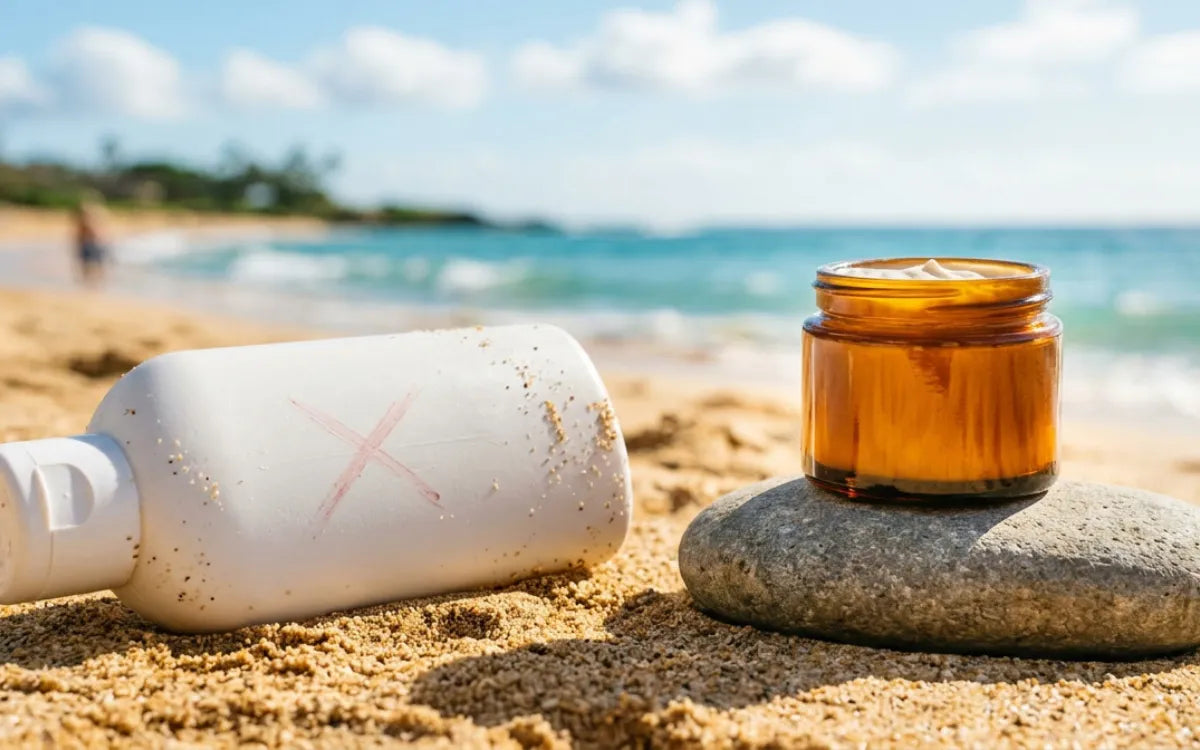
You put sunscreen on to protect your skin. But what if the very product you're using is doing more harm than good?
The truth is, most conventional sunscreens contain chemicals that penetrate your skin, enter your bloodstream, and disrupt your hormones. And the regulations meant to keep you safe? They haven't been updated since 1978.
What's Actually in Your Sunscreen?
Flip over your bottle and look for these common ingredients:
- Oxybenzone — The most concerning. Studies show it penetrates the skin within minutes, mimics estrogen in the body, and has been linked to hormone disruption, low birth weight, and coral reef destruction. Banned in Hawaii and Key West for its environmental damage.
- Octinoxate — Another hormone disruptor that interferes with thyroid function. Also toxic to marine ecosystems.
- Homosalate — Accumulates in the body faster than it can be eliminated. Disrupts estrogen, androgen, and progesterone.
- Avobenzone — Breaks down in the sun within 30 minutes (ironic, right?) and generates free radicals as it degrades.
- Retinyl Palmitate — A form of vitamin A that may actually accelerate skin damage and tumor growth when exposed to sunlight.
These aren't obscure ingredients. They're in the sunscreens sitting on most bathroom shelves right now.
The FDA's Uncomfortable Truth
In 2019, the FDA conducted a study that found six common sunscreen chemicals absorb into the bloodstream at levels that exceed their safety threshold — after just a single application. The agency then requested more safety data from manufacturers.
They're still waiting.
Of the 16 active ingredients used in sunscreens sold in the U.S., the FDA has only confirmed two as safe and effective: zinc oxide and titanium dioxide. Both are mineral-based, not chemical.
Chemical vs. Mineral Sunscreen
There are two fundamentally different approaches to sun protection:
Chemical sunscreens absorb into your skin and convert UV rays into heat. This is where the problematic ingredients live. They need 20-30 minutes to activate and break down over time.
Mineral sunscreens sit on top of your skin and physically reflect UV rays away. They work immediately, don't penetrate the skin, and use ingredients your body doesn't absorb — specifically zinc oxide and titanium dioxide.
Why Non-Nano Matters
Not all zinc oxide is created equal. Many mineral sunscreens use nano-sized zinc particles — small enough to penetrate your skin and potentially enter your bloodstream. That defeats the purpose.
Non-nano zinc oxide uses larger particles that stay on the skin's surface where they belong. They create a physical barrier without being absorbed. That's what we use in our Love & Protect formula.
What About SPF Numbers?
Here's something most people don't realize: SPF protection doesn't scale linearly.
- SPF 15 blocks 93% of UVB rays
- SPF 30 blocks 97% of UVB rays
- SPF 50 blocks 98% of UVB rays
- SPF 100 blocks 99% of UVB rays
The difference between SPF 30 and SPF 100 is just 2%. Yet higher-SPF products give people a false sense of security, leading them to stay in the sun longer and reapply less often — which actually increases their risk.
The FDA recommends broad-spectrum SPF 15 or higher, reapplied every 60 minutes during prolonged sun exposure.
A Better Way to Protect Your Skin
Our Love & Protect formula takes a different approach. Instead of loading your skin with synthetic chemicals, we combine the deep nourishment of organic grass-fed tallow with non-nano zinc oxide for natural, effective sun protection.
Every ingredient serves a purpose:
- Tallow, jojoba, and castor oil deeply moisturize and repair
- Vitamin E provides antioxidant protection against free radical damage
- Non-nano zinc oxide creates a safe physical barrier against UV rays
- Pure essential oils provide a gentle, natural scent
No oxybenzone. No octinoxate. No parabens. No hormone disruptors. Just clean protection that's safe for you, your kids, and the planet.
Fun in the sun should be blissful — not blister-full.